Solo
Kyrralíf, Academy Of The Senses, nr 4 Umhverfing/no 4 around
1 July — 30 September 2022
Academy of the Senses
Búðardalur / Iceland
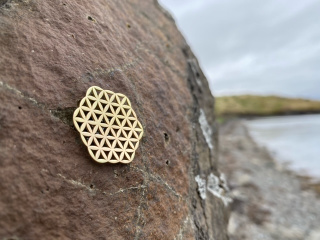
The Flower of Life is based on a play with mirrored circular forms, where the intersections of the rings become the core of the circles that follow.
This creates a rhythmic repetition that can multiply and expand infinitely, growing to the size of the universe itself.
This repetition can also become minuscule, reaching down to the tiniest unit of the Planck scale, the fundamental building block of reality.
Within this two-dimensional, repeated form lies a certain logic a compelling truth that our ancestors seem to have perceived and understood much as we still do today.
They believed this to be a sacred geometry: a kind of blueprint for reality itself.
What we now call the Flower of Life was, to the ancients, a key to existence.
The form contains a multitude of mathematical properties, including the five polyhedra that Plato considered to be the fundamental forms of the cosmos.
This geometric thinking, as expressed in the Flower of Life, appears to arise spontaneously and is found across many cultures.
The oldest known example can be seen in a calendar carved into the threshold of the palace of Ashurbanipal, king of Assyria, dating from around the sixth century BC, now preserved in the Louvre Museum in Paris.
Curator: collaborator Ástþór Helgason