Solo
One Thing and Another, and Then Some More
27 February — 24 April 2021
Galería Elba Benítez
Madrid / Spain
The artist’s third solo exhibition at the Galería Elba Benítez consists of a careful selection of works spanning the period of 1985 to the present, including works from earlier periods that have rarely been exhibited, as well as new works created especially for the exhibition.
“Art is what makes life more interesting than art.” Robert Filiou
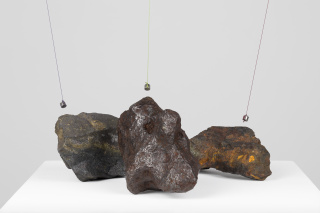
Hreinn Fridfinnsson’s work is as eclectic as it is idiosyncratic, but there are certain constants that run throughout its more than 50-year course, and among these is his use of the strategy of the objet trouvé — i.e. the taking of something from what is known (in rather questionable shorthand) as the ‘real’ world and re-contextualizing that thing in such a way that it might be considered (the questionability continues) as art. But Fridfinnsson’s use of the technique eschews the kind of irony or critique with which it is frequently associated, and instead tends toward light- but sure-handed revelations of the uncanny in the everyday, drawing specifically on the concreteness of the ‘real’ as a two-way portal to something else that is more lyrically and ethereally ’unreal’ — and yet that was in fact within the ‘real’ all along, hidden, or perhaps hiding, like the mysterious huldufólk [hidden people] who populate his native Iceland.
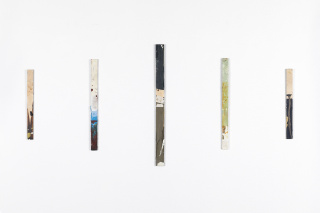
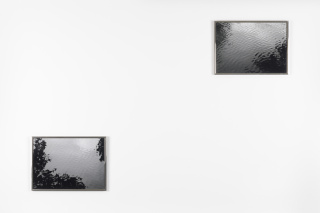
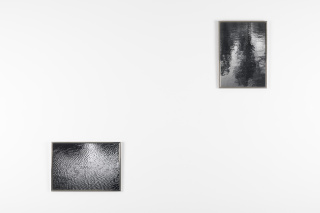
This aspect of Fridfinnsson’s work is evident throughout his current exhibition One Thing and Another, and Then Some More at the Galería Elba Benítez, an exhibition composed of significant works (some rarely exhibited previously) from across decades of the artist’s career. It is immediately apparent in the objets trouvés of the work Group of Five (2020)— an array of used and discarded paint-stirrers that, individually, result from a process of chance-based and thus unrepeatable collaborations with unknown collaborators in a local paint-shop in Amsterdam, and that, when juxtaposed and exhibited by the artist’s hand, come together to create a kind of immersive color field that would be impossible to experience in any other way. It is also present, albeit more subtly, in works such as Untitled (Water) from 1990, a diptych of black-and-white photographs of puddles, puddles that are by their nature unremarkable and eminently step-over-able and yet that, in their reflected and rippled surfaces, contain — but only briefly! — nothing less than the fullness of the ‘real’ world itself (this work, like others by Fridfinnsson, might also be read as a kind of artistic meta-response to the very medium of photography.) It even underlies Along a Line (1985) — a work that, remarkably, has only been shown once prior to the current exhibition, and yet that marked a turning-point in Fridfinnsson’s career, when he began to move beyond the photo and text-based conceptual works that had preceded it into more expansive wall-sculptures. In its contrapuntal progressions of line and color and scale, Along a Line channels unseen rhythms and patterns, much like those driving the work’s swirling tango dancers, or those in the color-waves of light refracted from its embedded glass prisms.
As with those irrepressible (yet so wonderfully benign) huldufólk, and indeed as with Fridfinnsson’s practice as a whole, the experience of the encounter with the works in One Thing and Another, and Then Some More leaves one happily wondering (in more than one sense of the word) — is art not also ‘real’?
Text by George Stolz
Photo: Jonas Bel
Exhibited works: