Group
SÚM I
12 — 20 June 1965
Ásmundarsalur and Café Mokka
Reykjavik / Iceland
SÚM is the name assumed by a group of young Icelandic artists, who did not adhere to any formal manifesto, and promoted an original programme of exhibitions with the purpose of renovating the contemporary Icelandic art scene, at the time mainly focused on abstract art, by creating a bridge between Iceland and international experiences such as Neo-dada, New Realism, Pop, and then Conceptual art. SÚM I was the first exhibition in which the four founding members of the group took part: Jón Gunnar Árnason, Hreinn Friðfinnsson, Sigurjón Jóhannsson, and Haukur Dór Sturluson. The name of the movement, soon joined by other artists, is the acronym of ‘Samband ungra myndlistarmanna’ (Association of Young Artists) – in opposition to the national FÍM (Association of Icelandic Artists) – but it also contains a reference to Descartes’s ‘Cogito ergo sum’ and, according to Árnason, it is the abbreviation of the word ‘Sumerians’.
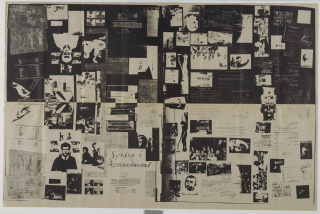
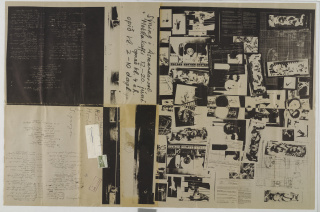
Designed by Dieter Roth, the catalogue of SÚM I consists of a folded poster printed on both sides.
The first years of activity were characterised by an irregular programme of events, until the group established its own space, Gallerí SÚM, in February 1969 on the first floor of a carpentry workshop in Reykjavik, where several personal as well as group exhibitions took place. Among them SÚM III (1969) was one of the most ambitious projects, bringing together works by 11 Icelandic and 17 international artists. In 1971, the group was invited to exhibit at the Museum Fodor in Amsterdam, another signal of international recognition. Some artists in the group participated in the annual outdoor exhibition organised by the Reykjavik Art School at Skólavörðuholt, from 1967 to 1972. For one of these events (in 1971 or 1972), Friðfinnsson first conceived a gate to be placed in an open space, leading to nowhere, but when its installation turned out to be logistically too complicated, he decided to present another work consisting of two mirrors, one tilted down, one tilted upwards. On the first night of the show, someone broke the mirrors, and therefore there is no documentation of this work, which was the first idea that led to Attending (1973), while the gate project was developed in Five Gates for the South Wind (1971–72).
After 1972, the movement slowly began to fade, and many of its members converged in the foundation of the Nýlistasafnið (Living Art Museum) in 1979, together with a group of younger artists and art students.
Photo: Pétur Ómar Þorsteinsson